


Why Europe cannot afford “cheapest-first” infrastructure
If you’re in the infrastructure industry, it is no secret that any “seemingly” cheapest project rarely turns out to be the cheapest in the end. It just “looks” cheaper on the day the contract is signed.
The real costs come later, in repairs needed too early in the built infrastructure’s lifetime, in traffic that moves too slowly due to poor quality, in safety risks that should never have existed, in higher emissions, and in the slow erosion of public trust.
Across Europe, too many infrastructure projects are still awarded primarily on one criterion: the lowest bid. It feels objective. It feels logical. It therefore feels fair. And so it is also politically easy to defend. But it has very little to do with how roads, bridges, railways, and utilities actually function over time.
Infrastructure is not a fast-moving product that you replace every few years. Most structures are designed to last 30, 50, or even 100 years. The European Commission estimates that Europe has over 5 million kilometers of paved roads and more than 1 million bridges, many of which were built in the post-war period and are now approaching or exceeding their intended design life.
How we build today shapes public safety, economic competitiveness, and environmental impact for generations. Therefore, the “cheapest-first” approach may seem optimal at the moment of signing, but it ignores the decades that follow.
Here’s a closer look at what it really creates.
It rewards minimal compliance rather than intelligent design
When price is king, design becomes a race to the lowest acceptable standard. Materials are chosen for cost, not durability. Construction methods prioritize speed over precision. Innovation feels risky because it might increase the bid (and therefore the loss of business/revenue). The result is infrastructure that technically works but ages faster, performs worse under harsh conditions, and needs “fixes” far sooner than expected.
This is not a theory. OECD studies show that infrastructure built without strong quality and durability requirements typically incurs 30 to 50 percent higher life-cycle costs due to early maintenance and rehabilitation. The money saved upfront is often repaid many times over.
It shifts costs to places that are not visible at the procurement stage
The project budget looks smaller, but the system becomes more expensive.
“Reconstruction” disguised as “maintenance” budgets grow year after year. Traffic disruptions become routine.
According to the European Commission, congestion already costs the EU economy over €100 billion annually in lost productivity. A significant share is driven by poorly timed repairs and premature asset deterioration.
Safety costs rise, too. Inferior materials and rushed construction increase the risk of accidents for both workers and users. These costs appear later as insurance claims, medical costs, and lost working hours. These costs rarely, if ever, appear in the original tender comparison.
Carbon costs also rise. Shorter asset lifespans mean more reconstruction, consuming more energy and producing more carbon. Cement accounts for roughly 7 to 8 percent of global CO₂ emissions. Building things twice instead of once is not cost-effective; it’s inefficient for the climate.
It blocks real sustainability
Sustainable construction almost never wins on upfront price alone. Longer-lasting structures, circular materials, digital monitoring systems, and low-emission machinery require planning and, at times, a slightly higher initial investment.
But they save money and reduce emissions over time. The International Energy Agency estimates that improving infrastructure durability and material efficiency could reduce global construction-related emissions by up to 20 percent by 2050. Cheapest-first procurement completely ignores that potential.
We end up with climate targets on paper and infrastructure that locks inefficiencies into the physical world for decades.
It punishes responsible companies
Companies that invest in skilled people, safety culture, digital quality control, and sustainable processes simply cannot compete with those who optimize only for price. Over time, the market drifts toward operators who cut corners best, not those who build lasting value.
This is how industries gradually weaken, not suddenly, but over time, due to incentives that promote the wrong goals and actions.
What Europe actually needs
What Europe needs is a deliberate and expedited shift toward “value-first” infrastructure. Value-first does not have to be expensive. It is about honest accounting. It entails evaluating projects based on what they truly cost and deliver over their full life cycle, including the following:
- Construction quality
- Maintenance needs
- Safety performance
- Carbon footprint
- Durability and adaptability
- Digital transparency
- Long-term cost to society
When we assess projects this way, something interesting happens. The cheapest bid often ends up being the most expensive. And the slightly higher upfront investment turns out to be the smartest financial decision.
In our previous article in this series, we saw that this is already happening in parts of Europe. We’ve seen how better models are gradually gaining ground:
- Life-cycle costing instead of pure upfront pricing
- Procurement weightings for sustainability and durability
- Scoring innovation and digital capability
- Relying on verified performance data rather than mere promises
This is rooted in fundamental economic principles, not merely an assumption.
Infrastructure constitutes Europe’s physical backbone, essential for enhancing defense readiness, trade, climate resilience, energy transition, and social stability. Viewing it merely as a commodity purchase is a strategic error.
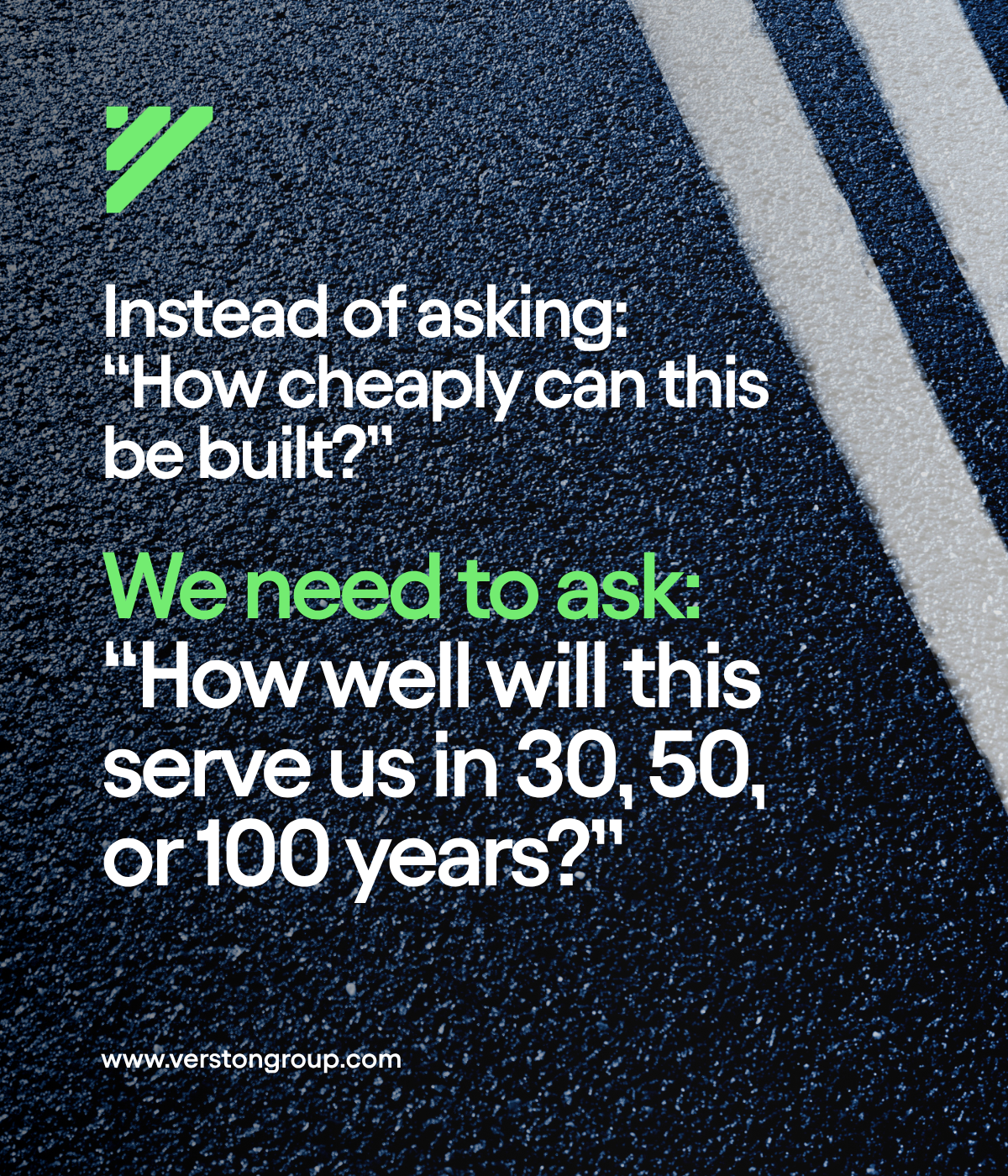
If Europe wants infrastructure that lasts, protects people, and supports its climate goals, we have to stop asking: “How cheaply can this be built?” Instead, we need to ask a far more responsible question: “How well will this serve us in 30/50/100 years?”
Note: Stay tuned for our next article in this series, where we will dive into what we can collectively do to bring about this shift from cheapest-first to value-driven thinking.